Lychee Fruit Cracking: Water Swings, Soil Calcium and Potassium Timing
Lychee fruit usually cracks during rapid fruit expansion, especially when heavy rain follows a dry spell: the flesh swells quickly and the skin cannot keep up. Prevention means steady soil moisture and correcting calcium by soil test in advance — not emergency high-strength sprays after cracking. In one Yu Her Pau orchard tested by the Kaohsiung station, available soil calcium was 66 mg/kg against a reference range of 570–1,140.
Why does lychee fruit crack?
During rapid expansion, the flesh grows faster than the skin. If soil moisture swings — especially heavy rain after a dry spell — the flesh takes up water quickly and the skin splits, which is why cracking often appears a few days after rain.
India’s National Research Centre on Litchi reports 10–30% cracking even in normal years and treats it as a major limiting factor, to be managed through water, bunch protection and nutrition together.
Test first: is the soil short of calcium?
Calcium is a cell-wall component tied to skin strength, but it moves slowly within the plant and depends on root uptake. In a Yu Her Pau orchard tested by the Kaohsiung District Agricultural Research and Extension Station, available calcium was 66 mg/kg (reference 570–1,140), magnesium 32 (reference 50–100), pH 5.3 (reference 5.5–6.5) and organic matter 0.69% (reference 2–4%).
The station recommended about 1,000 kg/ha of dolomite lime (supplying calcium and magnesium and raising pH) and 8,000 kg/ha of mature compost. Without fixing the soil, calcium sprays achieve little.
When to apply potassium
Potassium affects fruit water balance, coloring and sugar. In the same orchard, annual potassium chloride (about 480 kg/ha) was split 40% in July, 40% in January, 10% in March and 10% in April — mostly after harvest and before flowering, with only small amounts once fruit expands.
Heavy potassium and nitrogen during expansion make growth uneven; small, early, split applications support steadier fruit growth.
Keep soil moisture steady
Irrigate during dry spells so soil does not dry out completely before heavy rain, and mulch after fertilizing. The Indian litchi research centre recommends under-canopy micro-sprinklers for balanced water supply and bagging bunches 25–30 days after fruit set.
Late rescue does little
Heavy fertilizer or strong sprays once fruit is expanding cannot repair the skin and may cause salt injury. Move calcium and potassium management earlier — after harvest and before flowering — and keep water steady.
Fertilizers for the fruiting stage
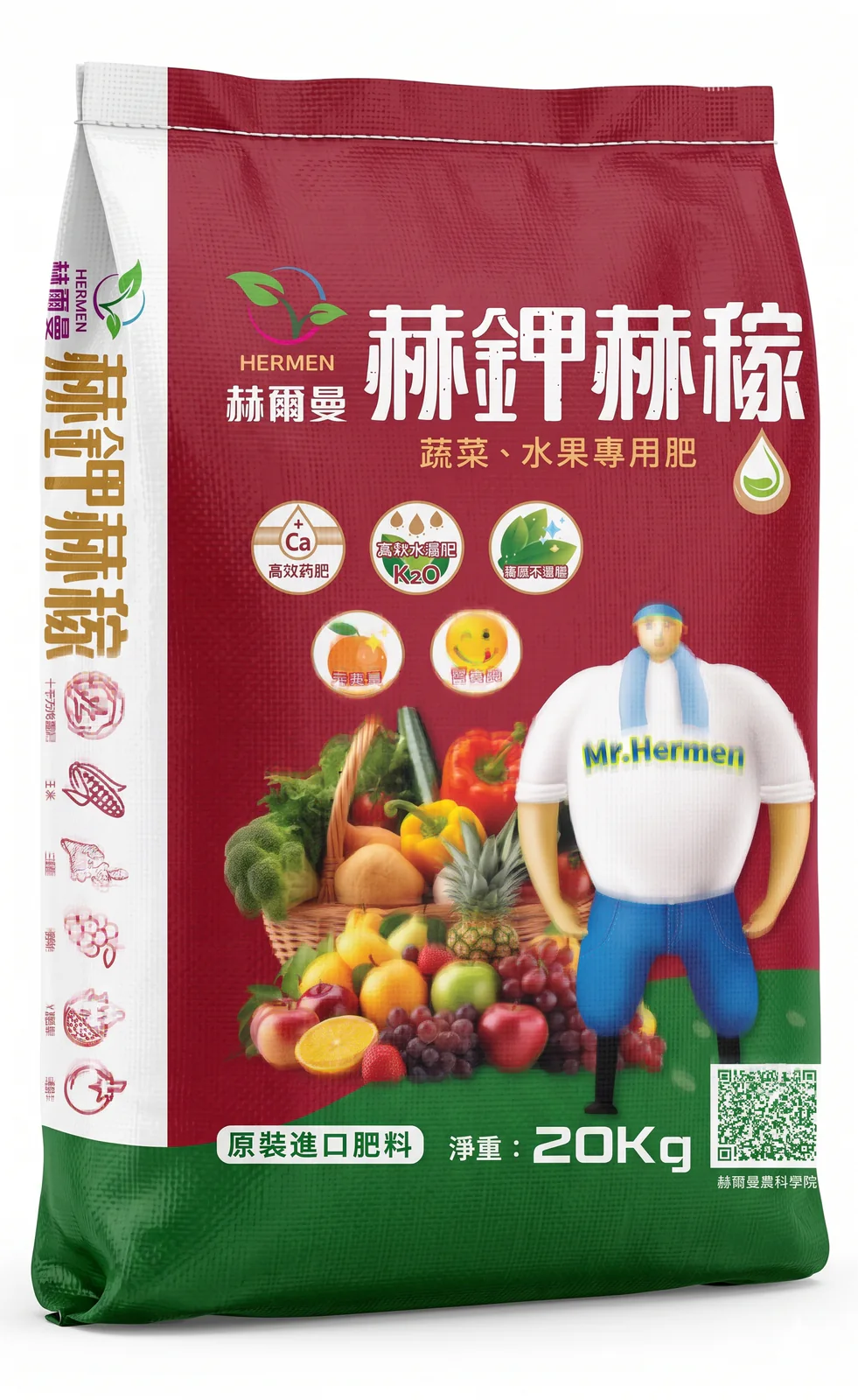
HERMEN Hejia Hejia (15-6-25+Ca) is a high-potassium fertilizer with calcium for fruiting through coloring, described on its product page as helping color, sweetness and reducing cracking. For fast calcium, Jen Gai Yong (granular calcium nitrate) is labeled for fruit trees in rapid growth and early fruit, with a note to pair it with steady irrigation. Follow the label and your soil test.
References
Lin, Y.H.: Rational fertilization of Yu Her Pau lychee — a case study, Kaohsiung District Agricultural Research and Extension Station.
Kumar, S., Das, B., Dhakad, A. et al.: Managing fruit cracking in litchi, Indian Horticulture 71(1), 2026 (ICAR-National Research Centre on Litchi).
Su, Y.S.: Rational fertilization of tea gardens, Tea Research and Extension Station (functions of essential elements).
FAQ
Moisture swings during rapid fruit expansion, especially heavy rain after drought: the flesh swells and the skin splits. Low soil calcium and thin-skinned varieties raise the risk.
Test the soil first. Where calcium is low and soil acidic, liming (about 1,000 kg/ha dolomite in the Kaohsiung example) addresses the cause better than sprays after cracking.
In the Kaohsiung station orchard, potassium chloride was split 40% July, 40% January, 10% March and 10% April — mostly after harvest and before flowering.
Keep soil moisture steady, correct calcium and potassium by soil test, avoid heavy feeding during expansion, and consider bagging 25–30 days after fruit set and micro-sprinklers.