Mango Flowers but No Fruit: Shoots, Pollination, Boron and Fertilizer Timing
Reliable mango fruiting is prepared a year ahead. The Tainan District Agricultural Research and Extension Station advises finishing pruning by August after harvest so bearing shoots complete at least two flushes before flower induction in mid-to-late November. Provide pollinators and watch for anthracnose and thrips during January–March flowering. Fertilize twice — after harvest and from flowering to before physiological drop — with half of each nutrient in each, finishing by April; in boron-deficient areas spray soluble boron at 1:500 every 10 days, two or three times.
No fruit set, or fruit set then dropped?
Flowers that never set fruit usually point to pollination, weather or disease. Fruit that sets and then falls points to water, tree vigor and nutrition. Decide which it is first.
Poor shoots mean poor flowers
The Tainan District Agricultural Research and Extension Station notes that each fruit needs about 25 leaves. One flush carries about 15 leaves, so bearing shoots need at least two flushes.
In Tainan, shoots flush after the June–August harvest, stop growing and begin flower induction in mid-to-late November, flower from January to March, set fruit about a month later and are harvested from June; Pingtung runs about 1.5 months earlier. Finish pruning by August, together with feeding, irrigation and pest control, so shoots mature in time.
Flowering: pollination and pests
Keep pollinating insects during January–March flowering and watch for anthracnose and thrips. Bag fruit early after set — ideally before April — which helps fruit growth and reduces spraying.
How much fertilizer per tree?
The station’s annual recommendations (g per tree): trees aged 1–3 years, 75 each of N, P and K; 3–5 years, 150 each. Mature trees by yield: 30 kg/tree — N 250, P 125, K 188; 45 kg — 300, 150, 225; 60 kg — 350, 175, 263. Roughly, every extra 15 kg of yield adds 300 g of fertilizer per tree.
Apply 20–30 kg of compost per tree as well. Increase rates by 30–40% on slopes and sandy or gravelly soils, reduce by 20–30% on retentive clay loams, and add 20–30% nitrogen while establishing a cover crop.
When to apply: half basal, half topdressing
Mature trees get two applications, with 50% of N, P and K in each and all compost in the basal. Apply basal fertilizer after harvest and pruning, buried about 20 cm deep in bands or rings, or in 4–6 holes 15–20 cm wide and 40–50 cm deep under the canopy. Use compost with no more than 2% nitrogen.
Topdress in March–April, from flowering to before physiological drop, alternating sides of the tree each year, and finish before April so residual nitrogen does not spoil fruit color. On flat land or high-nitrogen soils, topdress with phosphorus and potassium only; excess late nitrogen causes uneven coloring.
Boron and soil pH
In boron-deficient orchards, spray soluble boron at 1:500 from flowering to young fruit, every 10 days for two or three sprays. Mango suits pH 5.5–7.5; below 5.0, use manure compost, lime or dolomite gradually and stop at pH 6.5. Test soil and leaves at least every one to two years.
Fertilizer for flowering and fruit set
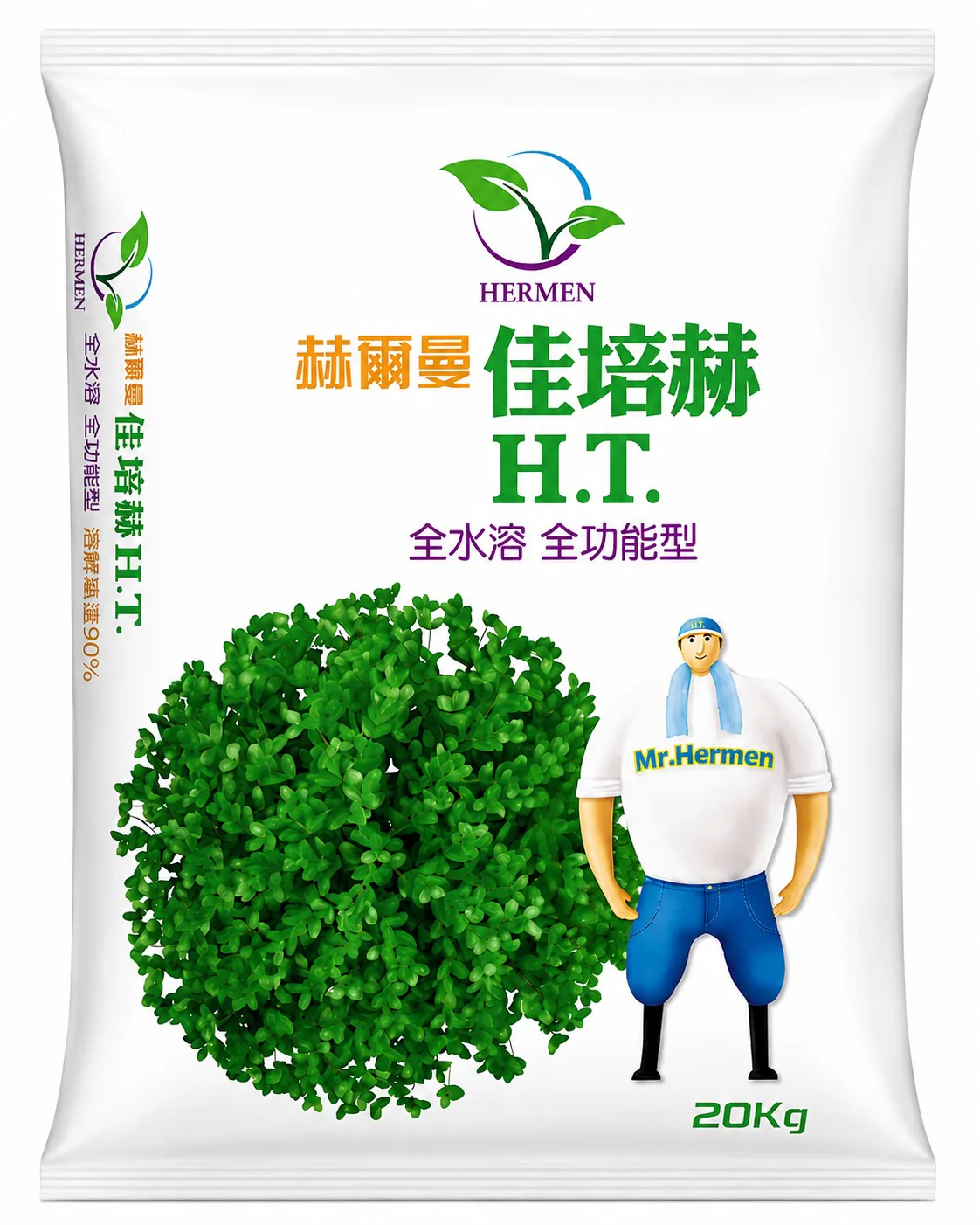
HERMEN Jiapeihe H.T. (18-22-10) is a high-phosphorus fertilizer for flowering through early fruit growth, described on its product page as supporting stable fruit set; Hejia Hejia, with high potassium and calcium, is used from coloring to harvest. Fit them into the schedule above and follow the label.
References
Chang, C.H. and Cho, C.J.: Demonstration of rational fertilization for mango in Yunlin, Chiayi and Tainan, Tainan District Agricultural Research and Extension Station.
FAQ
Common causes are bearing shoots without two full flushes, weak flower induction, lack of pollinators, anthracnose or thrips at flowering, and boron deficiency.
Twice for mature trees: basal after harvest and pruning, and a topdressing from flowering to before physiological drop (March–April), each with half the nutrients, finishing by April.
By yield: about N 250, P 125, K 188 g for 30 kg per tree; 300, 150, 225 g for 45 kg; 350, 175, 263 g for 60 kg — plus 20–30 kg compost.
In boron-deficient orchards, spray soluble boron at 1:500 from flowering to young fruit, every 10 days for two or three sprays. Confirm with soil or leaf analysis.